Max Bense was a significant supporter and
theorist of early computer art.
This webpage »red 40+1« displays the early editions of the »rot« (en: red) brochures,
a series of publications that was started in 1960 by Bense and his co-editor Elisabeth Walther.
max bense & the red edition
Max Bense (1910 - 1990) was professor of philosophy and technology at the TH Stuttgart and a major developer of the information aesthetics, providing a theoretical fundament for early computer artists. In his work he connected natural science, art and philosophy.
He was the driving force of the Stuttgart School/Group, which was devoted to experimental literature, especially visual and concrete poetry but also art in general.
Read more on the Stuttgart School and on Max Bense online at www.stuttgarter-schule.de (in German),
e.g. a text by Reinhard Doehl on Stuttgarter Schule.
Many »edition rot«-numbers - the earliest are on display here - contain experimental texts. But, as Reinhard Doehl describes, the numbers of the »red edition« were »slightly expanded catalogues of the exhibitions (...) Bense had been organizing in the (...) Studien-Galerie since the late 50s« which were »simply "camouflaged" by a cover«.
As mentioned, Bense was a major supporter of computer art. He enabled the first exhibition displaying computer art 1965 in Germany, which was most likely the first show of this kind worldwide. In February 1965 the mathematician Georg Nees presented his computer graphics at the gallery of TH Stuttgart for the first time.
No surprise that some texts important to computer art can be found in the »edition rot« edited by Max Bense and Elisabeth Walther in German.
Besides #6, a publication which includes two early computer-generated texts in German, the most important editions are the German translation of Abraham A. Moles »First Manifesto of Permutation Art«, #8, and computer graphics by Georg Nees with a text on generative aesthetics by Max Bense in #19.
rot #6
max bense: modelle.
In 1961 Max Bense published #6, where he presented experimental texts and poems (in German) describing their model character, among these were two computer-generated texts generated by the main frame computer ZUSE Z22 in Stuttgart, Germany. See the ZKM-clip ZUSE Z22 on youtube.
These two computer-generated texts are a stochastic text programmed by Theo Lutz and a Markovian text.
The Markovian text was created with statistical convergence and probability calculations according to the Markov chain. The data/words used were taken from a dictionary of frequent words in Francis Ponge s books (German editions), which was assembled by Elisabeth Walther and the team of the Stuttgart computer center. Monika Bense conducted the technical realization of the literature-experiment.
rot #6
max bense: modelle.
verlag der augenblick, 1961
printing: cantz, cannstadt
design: faigle stuttgart
1961, print run 512
rot #8
abraham a. moles: erstes manifest der permutationellen kunst
Abraham A. Moles (1920-1992) was a French engineer with a doctor s degree in physics and philosophy. Among other colleges and universities he held lectures at the TH Stuttgart and was professor at the university for design, the Hochschule fuer Gestaltung in Ulm, Germany.
Like Bense, Moles worked on information theory and aesthetic perception. His »Théorie de l'information et perception esthétique«, first released in 1958, is seen as a fundamental writing of the information aesthetics. »rot #8« is the first German edition of his manifesto.
rot #8
abraham a. moles: erstes manifest der permutationellen kunst
translation: monika bense, renate kübler, elisabeth walther
editor: max bense, elisabeth walther
printing: k. mayer k.g. stuttgart
cover design: walter faigle
typo with "IBM executive" by heide doehl
1962, print run 300
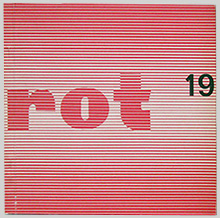
rot #19
computer-grafik. georg nees: programme. computer: stochastische grafik. max bense: projekte generativer sthetik.
»rot #19« is one of the earliest publications on computer art.
The brochure refers to the computer graphics exhibition initiated by Max Bense, the first known show of computer art world wide: Between February 5th and 19th the Studien-Galerie, a gallery at TH Stuttgart, presented computer graphics by Georg Nees, a mathematician. Together with A. Michael Noll and Frieder Nake, Nees is one of the pioneers of computer graphics.
As the title of #19 reveals, the computer is mentioned as one of the authors of this book: »computer: stochastic graphics«. A machine equally ranking between the artist Nees and author Bense was a provocation which caused irritation: Reinhard Doehl described the exhibition as »turbulent«.
Today, the exhibition as well as »rot #19« are widely regarded as milestones of computer art.
rot #19
computer-grafik. georg nees: programme. computer: stochastische grafik. max bense: projekte generativer sthetik.
editor: max bense, elisabeth walther
cover design: walter faigle
printing: hansjörg mayer
1965, print run 300
design: walter faigle
The red publications were designed by Walter Faigle. In the 1960s Faigle ran a studio for visual communication and photography in Stuttgart, Germany, and Zurich, Switzerland.
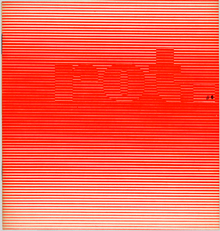
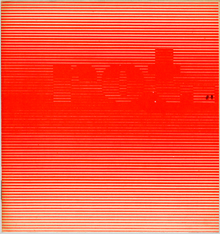
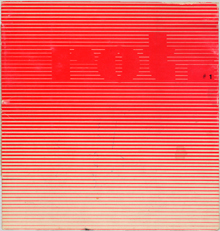
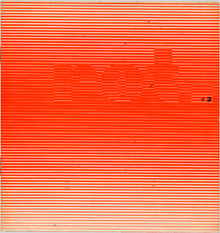
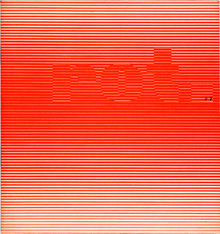
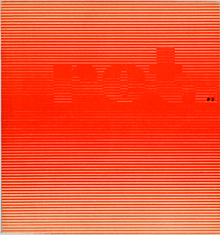
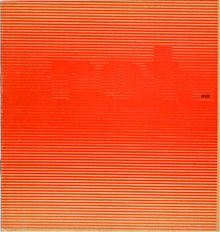
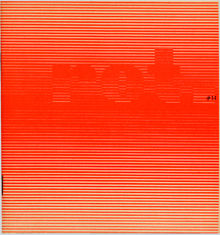
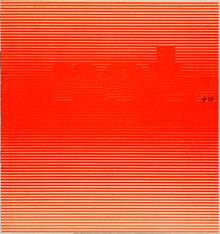
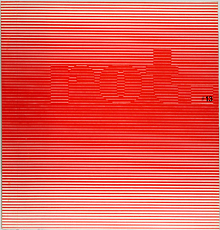
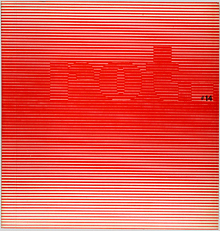
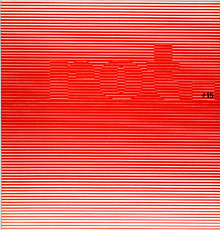
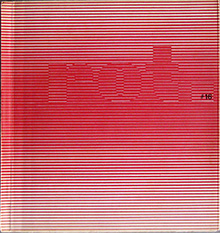
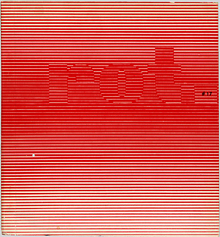
His cover design, shown in the first number of the red brochures from 1960 above, resembles the computer graphics of the years to come.
There is an obvious similarity of early computer art to art movements of that time like Op art und Concrete art.
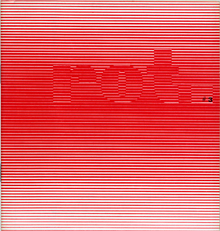
As can be seen in Faigle's cover design, the common ground seems to be the precision and particularly the invisible but noticeable mathematical structure the design is based on - no matter if it is a picture, a text or a piece of music.
rot #1 max bense: grignan-serie. beschreibung einer landschaft.
red secrets
»There are also red secrets in this world, yes, only red ones.« This Ernst Bloch quote is printed on the back of most red brochures in German. It was taken from the book »Heritage of our Times« which was published by the Marxist philosopher in 1935.
There is an interesting and also critical article on Bloch in the German magazine »der Freitag«: Denken als Handgemenge. Bloch s former assistant Hanna Gekle mentions the special relevance of this book for the analysis of art, literature and philosophy.
computer-generated texts
Like Concrete and Visual poetry, computer-generated texts belonged to the experimental field of the Stuttgart School. From the first stochastic poem in 1959 to the auto-poems (algorithmic poetry) of the 1960s and 70s these computer-generated works are pieces of early computer art.
Besides the German website www.stuttgarter-schule.de you can find a lot of information on computer-generated texts and poetry on www.netzliteratur.net, a website also in German, e.g. a chronology of computer texts.
A good read is Ralf Bülow s article on he history of mechanical and digital writings in the catalogue »Ex Machina« by Kunsthalle Bremen.
Reinhard Doehl, a member of the Stuttgart School, presented Concrete and Visual poetry as well as computer poetry on his still active website www.reinhard-doehl.de. His writings can be found in many »rot«-brochures, in red 40+1 there are: #2, #9, #21 and #40,
40 x red 1960-1969
rot #1
max bense: grignan-serie. beschreibung einer landschaft.
verlag der augenblick, 1960
printing: cantz, cannstadt
design: faigle stuttgart
1960, print run 400
A reprint of this title was published 1996 together with grignan 2 in #60.
rot #2
reinhard doehl: 11 texte.
verlag der augenblick, 1960
printing: cantz, cannstadt
design: faigle stuttgart
1960, print run 205
rot #3
jean genet fragmente.
special print edition for »augenblick«, 1960
printing: cantz, cannstatt
design: faigle stuttgart
1960, print run 410
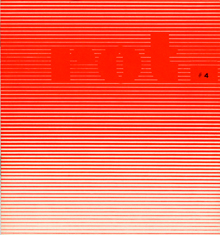
rot #4
20. juli 1944. lithos von paul wunderlich.
text von max bense.
verlag der augenblick, 1961
printing: cantz, cannstadt
design: faigle stuttgart
1961, print run 460
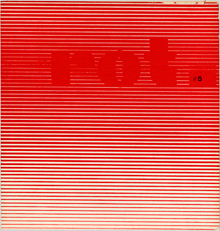
rot #5
ludwig harig: haiku hiroshima.
verlag der augenblick, stuttgart/siegen, 1961
printing: cantz, cannstadt
cover design: walter faigle
leporello
1961, print run 420
rot #6
max bense: modelle.
verlag der augenblick, 1961
printing: cantz, cannstadt
design: faigle stuttgart
inkl. flyer for edition rot
1961, print run 512
Klappentext rot #6:
»Die Texte, die als Modelle verwendet wurden, stammen von Gertrude Stein, Hegel, Helmut Heißenbüttel, Jean Genet, Reinhard Dühl, Ludwig Harig, Ferdinand Kriwet, Augusto de Campos, Ronaldo Azeredo, Eugen Gomringer, Gerhard Rühm und vom Autor. Der stochastische Text, programmiert von Th. Lutz, stammt aus der Stuttgarter Großrechenanlage ZUSE Z22. Der Markoffsche Text nähert einen Text aus der Sprache Francis Ponges an. Technisch wurde dieses Experiment von Monika Bense durchgeführt.«
rot #7
noigandres / konkrete texte.
haroldo de campos, décio pignatari, augusto de campos, ronaldo azeredo, josé lino grünewald.
helmut heissenbüttel: über konkrete poesie
ed.: max bense, elisabeth walther
printing: cantz, cannstadt
design: faigle stuttgart
1962, print run 180
rot #8
abraham a. moles: erstes manifest der permutationellen kunst.
bersetzung: monika bense, renate k bler, elisabeth walther
ed.: max bense, elisabeth walther
printing: k. mayer k.g., stuttgart
cover design: walter faigle
schrift auf "IBM executive" von heide dühl
1962, print run 300
rot #9
portr t einw nde. grafik klaus burkhardt. text reinhard dühl.
ed.: max bense, elisabeth walther
cover design: walter faigle
1962, print run 300
rot #10
georg kulka: aufzeichnung und lyrik.
nachwort: hermann kasack und helmut kreuzer
ed.: max bense, elisabeth walther
printing: k. mayer k.g., stuttgart
cover design: walter faigle
1963, print run 300
rot #11
max bense: vielleicht zun chst wirklich nur. monolog der terry jo im mercey hospital.
ed.: max bense, elisabeth walther
printing: k. mayer k.g., stuttgart
cover design: walter faigle
schrift auf "IBM executive" von heide dühl
1963, print run 300
rot #12
max bense, helmut heissenb ttel: k fige.
ed.: max bense, elisabeth walther
printing: k. mayer k.g., stuttgart
cover design: walter faigle
1964, print run 300
on sculptures by harry kramer.
image: automobile skulptur.
rot #13
hansjörg mayer: alphabet.
ed.: max bense, elisabeth walther
printing: hansjörg mayer
cover design: walter faigle
1964, print run 350
rot #14
joao cabral de melo neto: der hund ohne federn.
nachwort: haroldo de campos
bersetzung: willy keller
ed.: max bense, elisabeth walther
printing: hansjörg mayer
cover design: walter faigle
1964, print run 350
originaltitel: o cao sem plumas
rot #15
hellmut geissner: elliptoide
nachwort: ludwig harig
ed.: max bense, elisabeth walther
printing: hansjörg mayer
cover design: walter faigle
1964, print run 300
rot #16
ernst jandl: lange gedichte
ed.: max bense, elisabeth walther
printing: hansjörg mayer
cover design: walter faigle
1964, print run 300
rot #17
max bense: experimentelle schreibweisen
mit texten von helmut heissenbüttel, arno holz, gertrude stein, stephane mallarme, arno schmidt, jose lino grünwald und fernando pessoa.
ed.: max bense, elisabeth walther
printing: hansjörg mayer
cover design: walter faigle
1964, print run 325
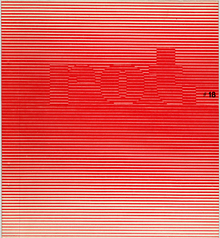
rot #18
friederike mayröcker: metaphorisch
ed.: max bense, elisabeth walther
printing: hansjörg mayer
cover design: walter faigle
1964, print run 440
rot #19
computer-grafik.
georg nees: programme
computer: stochastische grafik
max bense: projekte generativer sthetik
ed.: max bense, elisabeth walther
cover design: walter faigle
printing: hansjörg mayer
mayer
1965, print run 300
this edition shows six images of computer graphics
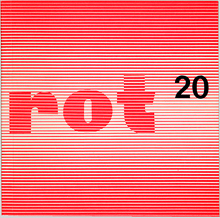
rot #20
charles s. peirce: ber zeichen.
bersetzung, nachwort und anmerkungen: elisabeth walther
ed.: max bense, elisabeth walther
cover design: walter faigle
printing: hansjörg mayer
1965, print run 500
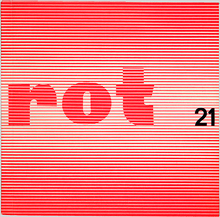
rot #21
konkrete poesie international.
nachwort : max bense
ed.: max bense, elisabeth walther
cover design: walter faigle
printing: hansjörg mayer
1965, print run 450
texte von: diter rot (dieter roth), edwin morgan, ian hamilton finlay, vagn steen, emmet williams, peter greenham, ladislaw novák, josef hirsal und bohumila grögerová, paul de vree, pierre garnier, john j. sharkey, dom sylvester houédard, yüksel pazarkaya, mathias goeritz, carlo belloli, eugen gomringer, gerhard rühm, ernst jandl, kurt sanmark, åke hodell, leif nylén, hans-jørgen nielsen, jörgen nash, augusto de campos, ronaldo azeredo, haroldo de campos, josé lino grünewald, franz mon, décio pignatari, reinhard döhl, timm ulrichs, konrad balder schäuffelen, edgar braga, pedro xisto, claus bremer, helmut heißenbüttel
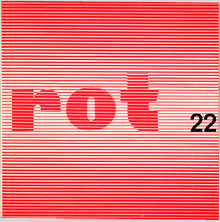
rot #22
konrad b. schäuffelen: en gros & en detail.
ed.: max bense, elisabeth walther
cover design: walter faigle
printing: hansjörg mayer
1965, print run 300
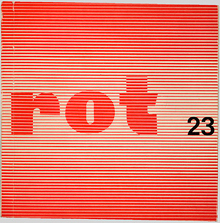
rot #23
hans dahlem: grafische kosmogonie.
anmerkung: ludwig harig
ed.: max bense, elisabeth walther
cover design: walter faigle
printing: hansjörg mayer
1965, print run 300
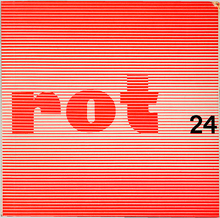
rot #24
klaus burkhardt: strukturen. siegfried maser: berechnungen.
ed.: max bense, elisabeth walther
cover design: walter faigle
printing: hansjörg mayer
1965, print run 300
die abgebildeten rosetten und strukturen von klaus burkhardt wurden im fotosatz auf den geräten starsettograph ts 61 und diatype hergestellt.
rot #25
haroldo de campos: versuchsbuch galaxien.
bersetzung: vilem flusser und anatol rosenfeld
ed.: max bense, elisabeth walther
cover design: walter faigle
printing: hansjörg mayer
1966, print run 470
ed.: max bense, elisabeth walther
cover design: walter faigle
printing: hansjörg mayer
1966, print run 500
ausgeführt als Leporello
rot #27
reinhold koehler: schrottstempel
ed.: max bense, elisabeth walther
cover design: walter faigle
printing: hansjörg mayer
1966, print run 500
rot #28
franz mon: 5 beliebige fassungen
ed.: max bense, elisabeth walther
cover design: walter faigle
printing: hansjörg mayer
1966, print run 500
rot #29
mira schendel: grafische reduktionen.
vorwort: haroldo de campos
nachwort: max bense
ed.: max bense, elisabeth walther
cover design: walter faigle
printing: hansjörg mayer
1967, print run 500
rot #30
francis ponge: praxis der sprache aus malherbe.
bersetzung und nachwort: elisabeth walther
ed.: max bense, elisabeth walther
cover design: walter faigle
printing: hansjörg mayer
1967, print run 500
rot #31
witold wirpsza: bruchs nden und todst cke.
bersetzung: maria kurecka
ed.: max bense, elisabeth walther
cover design: walter faigle
printing: hansjörg mayer
1967, print run 500
rot #32
diter rot: 80 wolken. 1965 bis 1967.
ed.: max bense, elisabeth walther
cover design: walter faigle
printing: hansjörg mayer
1967, print run 500
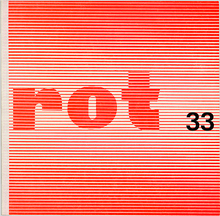
rot #33
timm ulrichs: lesarten und schreibweisen.
ed.: max bense, elisabeth walther
cover design: walter faigle
printing: hansjörg mayer
1968, print run 500
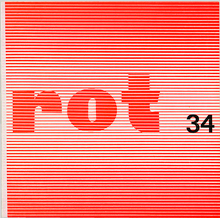
rot #34
günter neusel: fachwerke.
nachwort: max bense
ed.: max bense, elisabeth walther
cover design: walter faigle
printing: hansjörg mayer
1968, print run 500
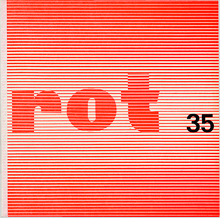
rot #35
johannes e. seiffert: hier sei kühl.
ed.: max bense, elisabeth walther
cover design: walter faigle
printing: hansjörg mayer
1968, print run 500
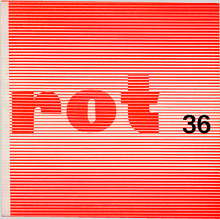
rot #36
g.w.f. hegel: vorlesungen über die ästhetik. eine auswahl herausgegeben von max bense.
ed.: max bense, elisabeth walther
cover design: walter faigle
printing: hansjörg mayer
1968, print run 578
auswahl nach der fromannschen ausgabe, tübingen 1953, ed. hermann glockner
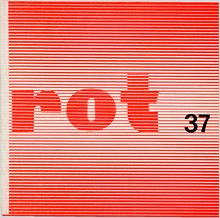
rot #37
george d. birkhoff: einige mathematische elemente der kunst.
translation: elisabeth walther
ed.: max bense, elisabeth walther
cover design: walter faigle
printing: hansjörg mayer
1968, print run 592
original title: quelqes elements mathematiques de l-art
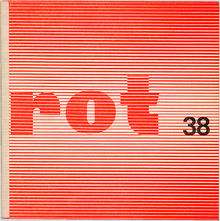
rot #38
max bense: kleine abstrakte sthetik.
ed.: max bense, elisabeth walther
cover design: walter faigle
printing: hansjörg mayer
1969, print run 1177
copy with dedication, signed "mb." (probably Max Bense 1971)
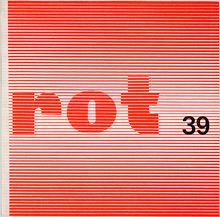
rot #39
aloisio magalh es: der weg eines zeichens. text und fotos.
nachwort: max bense
ed.: max bense, elisabeth walther
cover design: walter faigle
printing: hansjörg mayer
1969, print run 570
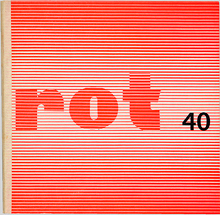
rot #40
klaus burkhardt / reinhard döhl: poem structures in the looking glass.
typografische figurationen.
cover design: walter faigle
printing: hansjörg mayer
1969, print run 500
most poem structures presented in this edition were created with diatype, some others with a staromat.
+ 1: red #41
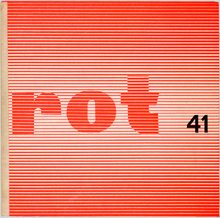
rot #41
konkrete poesie international 2.
ed.: max bense, elisabeth walther
cover design: walter faigle
printing: hansjörg mayer
1970, print run 550
texte von: joe michaud (usa), shutaro mukai (japan), peter mardersteig (deutschland), ingrid von oppenheim (deutschland), ronald draper (england), hans amadeus rosa (schweiz), elena asins (spanien), leon spiro (usa), yüksel pazarkaya (türkei), joaquim branco (brasilien), kahtan al madfai (irak, übersetzung: a. el hakim), carlos alvear (argentinien), aquiles branco (brasilien)
The last title of the red edition, #62, was published in 1997.
Find the complete list of edition rot at www.stuttgarter-schule.de